If you were to aske me if I wanted to go stand in the middle of a street with a million other people (yes its actually close to a million people I looked it up on Wikipedia,) wear weird glasses, and get frost biten toes, I would have to politely decline.
It is a rather odd tradition, our normal New Year's Eve. I am sure it is quite an experience to be in Times Square while people hoot and holler in you ears. For me I would much rather be at home where I can get a better view of the ball and have the ability to turn down the volume of the jubilant celebrators. If I am at home I could also watch the drop live at 11 and then not bother staying up to watch it again at 12.
Some people love the ball drop, but I personally don't consider it that special. Sure, it is a big and colorful ball, but it doesn't really "drop." It just slides very slowly down a pole and makes some numbers light up. It happens every year, and the only change makes you write the date incorrectly for a week. I remember when I was little and first learned of the ball drop, I initially thought of a disco ball. This was followed in short succession by an image of someone cutting the string and a falling disco ball, a real "ball drop." That made me wonder if the ball would break, and then what a broken or shattered disco ball would look like. In my mind it is much like a pile of silver glitter.
Despite my personal views, Times Square is full every single year. It is obvious that others think differently of this celebration. There is value in the experience, and that's what draws the big crowds. Maybe someday I will also value this opportunity and wish to see it live, but that is not now. Now it is just good for a few days off.
Monday, December 31, 2012

Monday, December 17, 2012

Sunday, December 16, 2012
In the Wake of Tragedy
This past week was a hard one at that. With the passing of a classmate and then the school shooting in Connecticut, I wish that I had some sort of deep and profound words, but then again, don't we all. Here in a rather dark post I will give my take on death and the light at the end of the tunnel.
I'll come out and say that I haven't had much personal experience with death. All of my grandparents and one of my great-grandparents are still living. The only other two great-grandparents I knew died when I was in the first few years of elementary school. Before the second of them died, my mom had gone out east to visit one last time. She called with the news and my dad told me. From what I can remember I really didn't have any initial reaction. It wasn't until after my sister got emotional that I felt more. It is hard to predict your response to death, and thinking about others dying is just depressing.
In our society death is always something that is feared. However, this fear is more or less only an enlarged child-like fear of the dark. Both are the fear of the unknown, but in one case there is a light-switch available. I am not sure if this fear that we have is warranted. I know there have been times when I have both feared, and not feared death, but if it is listed behind public speaking, like it often is, I should be alright.
I don't have much to say about David and the events in Connecticut. Both cases are very sad, but I don't have much of a connection to either. They are not much, but my condolences go to families and friends in both cases. It's not that I'm an emotionless robot, but I don't show much as a result of death, so I sit here typing stone-faced about these events claiming that I'm sad.
I'll come out and say that I haven't had much personal experience with death. All of my grandparents and one of my great-grandparents are still living. The only other two great-grandparents I knew died when I was in the first few years of elementary school. Before the second of them died, my mom had gone out east to visit one last time. She called with the news and my dad told me. From what I can remember I really didn't have any initial reaction. It wasn't until after my sister got emotional that I felt more. It is hard to predict your response to death, and thinking about others dying is just depressing.
In our society death is always something that is feared. However, this fear is more or less only an enlarged child-like fear of the dark. Both are the fear of the unknown, but in one case there is a light-switch available. I am not sure if this fear that we have is warranted. I know there have been times when I have both feared, and not feared death, but if it is listed behind public speaking, like it often is, I should be alright.
I don't have much to say about David and the events in Connecticut. Both cases are very sad, but I don't have much of a connection to either. They are not much, but my condolences go to families and friends in both cases. It's not that I'm an emotionless robot, but I don't show much as a result of death, so I sit here typing stone-faced about these events claiming that I'm sad.
Sunday, December 9, 2012
Hate
Narration
When in elementary school, there was another kid that really
made me mad. In the classroom or
on the playground, there was something about him that just didn’t sit well with
me. For some reason or another one
day I told my mom I hated him. Her
reply, “You don’t really hate him. Try to be his friend.” Of course that made me more mad, but I
realized she was right. I didn’t
hate him after that I just strongly disliked him.
Description
A dark figure slinks, sneaking in the shadows. It waits for the right moment to be
called upon. Anyone and anything
can provoke it to rise out of anger.
It is ready in an instant to grow, to swell, into a fiery demon driven
with emotion. No matter how much
water you pour on its fire, the flame will not be doused. Forever, internally flickering, waiting
for kindling, another spark to return, take control, and consume you with its
presence.
Example
Possibly the oldest hate rivalries are religious. Why we must bash each other over what
higher power we do or do not praise seems crazy to me. There are plenty of ways prove you are
superiority to someone else, say, a game of rock-paper-scissors, or better yet
a game of rock-paper-scissors-lizard-Spock. Yet humans often resort to physical violence. For thousands of years the Arabs and
Israelis have fought each other because neither has been able to see past their
hate for the other. Tom Lehrer
shed some light on this with his carefree chords. “Oh, the Protestants hate the
Catholics, and the Catholics hate the Protestants, and the Hindus hate the
Muslims, and everybody hates the Jews.”
Compare/Contrast
There is a definite difference between hate and anger. They are certainly connected. Anger is
usually the precursor to hate or the beginning stage. Yet hate and anger are miles apart. Anger is petty, and comes from simple
everyday life situation that prove irritating. It comes and goes easily with the passing moments, and can
easily be suppressed. Hate rarely
comes in the spur of the moment.
It is taught and learned from repeated anger, conditioned into
existence. You must work to
control hate. Unfortunately, hate
towards someone or something can never be fully obliterated. It always lingers, even after it is
resolved.
Process Analysis
Hate: A How to Guide.
Why would you ever want to intentionally hate? I don’t know, but here are my NUMBER steps to hatred. One, find something that annoys you,
something irritating. This could
be something new or something you have already been exposed to. Two, surround yourself with this
nuisance, but don’t accept its being.
Deny its existence until it eats at you. Then, relieve yourself. Separate from it.
Live without it. Forget
about it. Feel how nice it is, to
live without this pestering nuisance.
Finally, go back to it. Let
it return to your life. At first
you will be able to deal with it.
Next you will build up the same anger you had before. Then it will consume you with utter
loathing. You will be pushed to
the brink, and will fall into the endless pit of hate.
Division of Analysis
Do not be too quick to jump to the conclusion that you hate
something. Hate is the top rung of
a very tall ladder. Underneath it
are many feelings that may cause the “I hate this” utterance. On the bottom is simple dislike. In my opinion it is follow by
abhor. I have always found this a
funny word and can’t quite take it seriously, so it is not very high on the
hate scale. Next we have despise and detest. These are the gateway into the harsher malevolence, rancor,
and loathing. All of these
feelings are slightly different and are present in different situations. However, none of them are parallel to
pure hate.
Classification
Hatred appears readily in children’s stories and
movies. The evil doer, always a
solitary person radiates hatred.
There is never a reason for their hate, but they are evil and out to get
anyone who is not. Often these
characters are either so evil that they are destroyed in the end, or are deep
down just kind and misunderstood people.
In a way it is disappointing that there is never reason fro their anger
and hate, it just seems to be their natural disposition.
Cause and Effect
Scientific studies have linked the brain activity of love
and hate. Although they are
opposite feelings, their source involves the same areas of the brain. The “hate circuit” when stimulated by
some environment produces a reaction of aggression and anger in the brain
translating to hatred.
Definition
“Hate: a feeling of intense or passionate dislike.” Hate
does not deserve its own definition.
It is not something that can stand alone on its own. All that I have said up to this point
is moot. Hate is not a thing, it
is a vacancy a hole, a pit. It is
the absence of love, much the same way that cold is the absence of heat. It is a destructive and powerful thing,
or non-thing, that tears people apart.
Argument/Persuasion
So what do we do about hate? I will call upon the good Dr. King for that. “I have decided to stick to love...Hate is too great a
burden to bear” because “Darkness cannot drive out darkness: only light can do
that. Hate cannot drive out hate: only love can do that.” Therefore I propose we set out in love
to do battle against the hate that has manifested itself in our world. It will never fully be driven away, but
can be pushed to the smallest corner of the most remote region of the earth.
When I googled hatred this came up. I found the comments quite amusing, specially the top comment by TanongSak and the comments on it.
Tuesday, December 4, 2012
Hawaii Day
At my elementary school there were annual activities that took place in every grade. One of these events that I remember more keenly than others was Hawaii day when I was in the second grade. It entailed just what its name might imply. All of the different classes grouped together and took a "trip" to Hawaii for a day filled with exotic fun and games.
We began our journey seated to the islands on the flight there. Fortunately it lasted all of eight minutes instead of the eight hours it would have taken to get there. Shortly upon arriving we set up our spot on the beach (or the gymnasium floor) with our beach towel, which we had been instructed to bring, in our tropical clothes, that we had been instructed to wear. The rest of the day turned into a magical island experience. We had scavenger hunts on the island play ground, made colorful leis, and grass skirts. Nothing could have topped the day of better than the poi snack in the afternoon. It is fond memory that I am sure we all remember.
This day emphasized culture and knowledge that comes with exposure to different places. I am unaware if that day was supposed to have education implications, probably because I was to busy attempting a hula dance. I now realize the importance of travel in education. I thank my parents for all of the opportunities that they have given my sister and I to see the world. I feel that there is a very good connection between my time my family spent on trips and the well rounded academics that I take part in.
For years our spring break tips took my family all around the country, and only occasionally included time spent relaxing on a beach. Even when we actually did go to Hawaii we spent a good deal of time hiking the Napali coast of Kauai. Other trips consisted of museums and historical monuments that inspired imagination. These trips encouraged me to imagine, and cause me to invest time in research both before and after trips. I wanted to emulate my parents, who are both very smart in their own regard.
While I may have not realized it at the time, Hawaii day was the beginning of an adventure abroad that has brought me to thirty-some odd states and four countries outside the U.S. I know that I have been very fortunate to see a variety of places and believe that my academics were positively affected by this. I am still a long way from getting, or even looking, for a job, but my experiences have given me an advantage and inspiration to find something that I will love.
We began our journey seated to the islands on the flight there. Fortunately it lasted all of eight minutes instead of the eight hours it would have taken to get there. Shortly upon arriving we set up our spot on the beach (or the gymnasium floor) with our beach towel, which we had been instructed to bring, in our tropical clothes, that we had been instructed to wear. The rest of the day turned into a magical island experience. We had scavenger hunts on the island play ground, made colorful leis, and grass skirts. Nothing could have topped the day of better than the poi snack in the afternoon. It is fond memory that I am sure we all remember.
This day emphasized culture and knowledge that comes with exposure to different places. I am unaware if that day was supposed to have education implications, probably because I was to busy attempting a hula dance. I now realize the importance of travel in education. I thank my parents for all of the opportunities that they have given my sister and I to see the world. I feel that there is a very good connection between my time my family spent on trips and the well rounded academics that I take part in.
For years our spring break tips took my family all around the country, and only occasionally included time spent relaxing on a beach. Even when we actually did go to Hawaii we spent a good deal of time hiking the Napali coast of Kauai. Other trips consisted of museums and historical monuments that inspired imagination. These trips encouraged me to imagine, and cause me to invest time in research both before and after trips. I wanted to emulate my parents, who are both very smart in their own regard.
While I may have not realized it at the time, Hawaii day was the beginning of an adventure abroad that has brought me to thirty-some odd states and four countries outside the U.S. I know that I have been very fortunate to see a variety of places and believe that my academics were positively affected by this. I am still a long way from getting, or even looking, for a job, but my experiences have given me an advantage and inspiration to find something that I will love.
Sunday, December 2, 2012
Why the Vikings Need to Make It to the Super Bowl
I do not consider myself a Vikings fan. Even though I have lived in Minnesota for most of my life I have never had a strong attraction to purple and gold. I check the scores in the newspaper on Monday morning, occasionally watch some of the games on TV, and I even went to a preseason game once, but nothing has sparked my interest. The much disputed new stadium bill passed and a new stadium is on the way. With a loss today to the Packers they sit with an even 6-6 record, and it is unlikely they will actually make it to the Super Bowl, but they to do something to earn their new stadium
If fans could get a team to the Super Bowl I am sure that Vikings fans would find a way to do it. Crazy guys dress up and paint their bald heads purple every week for the game. They yell, scream, hoot, and holler, 'til the veins in their neck pop out and they resemble real vikings (minus the purple). The other thing about Vikings fans is that they are whole-hearted and true to their team. The Vikings fans I know are not fair weather fans. They stick with their team through the good, and grit their teeth through the bad, and always criticizing the Saints for 2010. I am an exception, an oddity to the Vikings fan norm, but I don't consider myself a fan, so it shouldn't even matter. Their fan base is plenty and far-reaching, and these fans deserve some well earned payout. The last few years have been uncharacteristically bad for the Vikings, and even though I said their fans were loyal, a losing season would not help there support.
The team may not be as strong as it has been in the past, but they have plenty of capable players both young and old. Defensive players like Jared Allen and Antoine Winfield provide leadership, and young players like Matt Kalil have stepped up into big shoes. And the talented Adrian Peterson leads the 3rd best rushing attack in the league. All I will say about Christian Ponder is that he is doing what is to be expected from him, sometimes more, and sometimes less. He is a very young quarterback maybe an investment in him will pay off, or maybe we will still be in the same situation in five years. Either way they aren't a team comprised of all stars, nor one of complete nincompoops. Just like all other Minnesota sports teams they should be good enough to win, and win more 50% of the time. But for some reason they still don't.
If only, if only the woodpecker sighs, fanatic fans, and a half decent team could win a championship. The beginning of this year seemed to be looking up from last year. Every week in the Star Tribune's game recap they give the outlook of the team. A few weeks in the outlook was "Horns Up", but I have seen an increase in "Horns Down" lately. There has been plenty of finger-pointing, and lots of jaw-wagging, but nothing has been done. Someone needs to step up and do something. I believe they are capable, but change is necessary. They are getting a new stadium in a few years, and the team that is playing now doesn't deserve it.
If fans could get a team to the Super Bowl I am sure that Vikings fans would find a way to do it. Crazy guys dress up and paint their bald heads purple every week for the game. They yell, scream, hoot, and holler, 'til the veins in their neck pop out and they resemble real vikings (minus the purple). The other thing about Vikings fans is that they are whole-hearted and true to their team. The Vikings fans I know are not fair weather fans. They stick with their team through the good, and grit their teeth through the bad, and always criticizing the Saints for 2010. I am an exception, an oddity to the Vikings fan norm, but I don't consider myself a fan, so it shouldn't even matter. Their fan base is plenty and far-reaching, and these fans deserve some well earned payout. The last few years have been uncharacteristically bad for the Vikings, and even though I said their fans were loyal, a losing season would not help there support.
The team may not be as strong as it has been in the past, but they have plenty of capable players both young and old. Defensive players like Jared Allen and Antoine Winfield provide leadership, and young players like Matt Kalil have stepped up into big shoes. And the talented Adrian Peterson leads the 3rd best rushing attack in the league. All I will say about Christian Ponder is that he is doing what is to be expected from him, sometimes more, and sometimes less. He is a very young quarterback maybe an investment in him will pay off, or maybe we will still be in the same situation in five years. Either way they aren't a team comprised of all stars, nor one of complete nincompoops. Just like all other Minnesota sports teams they should be good enough to win, and win more 50% of the time. But for some reason they still don't.
If only, if only the woodpecker sighs, fanatic fans, and a half decent team could win a championship. The beginning of this year seemed to be looking up from last year. Every week in the Star Tribune's game recap they give the outlook of the team. A few weeks in the outlook was "Horns Up", but I have seen an increase in "Horns Down" lately. There has been plenty of finger-pointing, and lots of jaw-wagging, but nothing has been done. Someone needs to step up and do something. I believe they are capable, but change is necessary. They are getting a new stadium in a few years, and the team that is playing now doesn't deserve it.
Thursday, November 29, 2012
Monday, November 26, 2012
Old Geezer
Every year my family heads out east to visit my grandparents. When you look at my grandfather sitting in his arm chair watching the Red Sox, he looks like a grumpy old man. He is a retired Massachusetts cop that very much resembles the comic strip character Crankshaft. He always greets us with a smile and a hug, which can be difficult with his enlarged mid-section. He smells like aftershave, and my mom always gets him razor blades for Christmas to which he exclaims "I needed these." He is balding on the top of his head and has a comb-over with the little hair that he has.
We enjoy talking baseball together and I am quick to rub in the fact that the Twins recently beat the Sox in a four game series. Every night he can be found watching the game every night on NESN and grumbles when he sees the Sox gave up a home run, and is followed shortly by snide remark about how the the manager left the pitcher in too long, or about how a player "gets paid millions of dollars, and he stinks!" He was fine with the late manager Bobby Valentine, but always had plenty to say about Terry Francona, and was happy to see him go. When the game gets really out of hand he switches the channel to Fox News. It is unbelievable how well he fits the conservative old man stereotype. He is very cheap and we often accuse him of cheating at cards.
At our cabin out there he tries to do too much work, and my mom scolds him for it and usually tells me to do it instead. Whenever he walks he hums a little tune. I can't tell if it is actually humming or if its more wheezing because he is out of shape. Either way its always the same and I can't remember him not doing it. The only exercise I have every seen him do are short swims on nice days at the lake, and taking their golden retriever on walks. He spoils the dog and my uncle calls the only 3-year-old dog a golden receiver that acts like an old lady. The dog is needs to be dragged if she doesn't get treats while on her walk. My grandmother always gets mad when my grandfather leave little dog treats in his pockets, and they go through the wash, coming out as little mush-balls.
My family always gives him a hard time, but we love him the same.
We enjoy talking baseball together and I am quick to rub in the fact that the Twins recently beat the Sox in a four game series. Every night he can be found watching the game every night on NESN and grumbles when he sees the Sox gave up a home run, and is followed shortly by snide remark about how the the manager left the pitcher in too long, or about how a player "gets paid millions of dollars, and he stinks!" He was fine with the late manager Bobby Valentine, but always had plenty to say about Terry Francona, and was happy to see him go. When the game gets really out of hand he switches the channel to Fox News. It is unbelievable how well he fits the conservative old man stereotype. He is very cheap and we often accuse him of cheating at cards.
At our cabin out there he tries to do too much work, and my mom scolds him for it and usually tells me to do it instead. Whenever he walks he hums a little tune. I can't tell if it is actually humming or if its more wheezing because he is out of shape. Either way its always the same and I can't remember him not doing it. The only exercise I have every seen him do are short swims on nice days at the lake, and taking their golden retriever on walks. He spoils the dog and my uncle calls the only 3-year-old dog a golden receiver that acts like an old lady. The dog is needs to be dragged if she doesn't get treats while on her walk. My grandmother always gets mad when my grandfather leave little dog treats in his pockets, and they go through the wash, coming out as little mush-balls.
My family always gives him a hard time, but we love him the same.
Sunday, November 25, 2012
Thanksgiving Extravaganza
Thanksgiving is always a fun time of year. Fortunately, in my family nothing too crazy happens. Normally my grandparents host Thanksgiving. However, this year we had it at our house. I am not exactly sure why, but it was fine none the less.
Barry's Lost in the Kitchen, while funny was not the full truth this year. I had to peel potatoes and carrots for our meal. I did get out of doing the dishes afterward because I was watching football, but I at least helped a little. As was to be expected, my mom got a bit stressed out. The whole house was clean and everything was set right, but once the rest of the family had arrived and the gravy was not quite ready, well you just didn't want to be in her way, as was normal when any company came over. Grandma always offers to help, but my mom always says she doesn't need any. It is quite the opposite when Thanksgiving is at my grandparents, my mom always helps finish last minute preparations. My dad is usually the one who carves the turkey, but it isn't a big deal like it is sometimes made out to be in the media. This year all the food got done, nothing was burned, and the house didn't catch on fire, so it was a plus in my book (not that any of these things happen normally).
It always takes everyone a minute to get seated, even thought the food is already on the table. There is no particular place for anyone. For obvious reasons, I always try to find one of the more comfortable chairs that is close to food. Once everyone is settled my grandfather says grace. He does this every year seeming reluctant, but I think he really enjoys doing it. After the food is passed around and everyone is eating, my uncle and I make fun of my cousin, who being a vegetarian has only potatoes, carrots and green beans on her plate. He has a very distinct and hearty laugh that is easily recognizable and frequently heard at family events. I was surprised this year to see that he didn't have his usual Mountain Dew with him. My aunt has an equal loudness about her. She has an exciting buzz about her that brings an interesting dynamic to Thanksgiving . I notice that she is the one who always drinks the most wine. I have yet to discover if there is a correlation between these two things.
No matter how much everyone eats there is always room for dessert. My grandma always makes delicious pies and real whipped cream. I think it was a relief this year that she didn't have to cook the whole meal. Never the less she brought three different types of pie. My sister exclaims that she can't eat the apple pie that they have in her school's dining hall because "Its just disappointing compared to grandma's." After a piece of each kind I am thoroughly full. The conversation goes on about school and how my sister has been. This is the longest she's been home in over 6 months. Everything slowly dies down and we clear the table. I go off and watch football, while everyone else talks more.
Not too long after that everyone leaves. My aunt and uncle are the first to leave. This is true no matter where we have Thanksgiving. I was always upset when we were the last ones to leave my grandparents. We helped clean up and do the dishes even though everyone had already gone. Nobody stayed to help us this year, but I don't mind because I got out of doing the dishes too like I already mentioned. I was conveniently watching football and wasn't asked to help.
I am thankful for the family that I have. We all have our quirks, but none of us are like the crazy people you hear about in stories. It is about the same every year, but I don't mind. It's always good to reconnect with family. We get to do it all over again in a month.
Barry's Lost in the Kitchen, while funny was not the full truth this year. I had to peel potatoes and carrots for our meal. I did get out of doing the dishes afterward because I was watching football, but I at least helped a little. As was to be expected, my mom got a bit stressed out. The whole house was clean and everything was set right, but once the rest of the family had arrived and the gravy was not quite ready, well you just didn't want to be in her way, as was normal when any company came over. Grandma always offers to help, but my mom always says she doesn't need any. It is quite the opposite when Thanksgiving is at my grandparents, my mom always helps finish last minute preparations. My dad is usually the one who carves the turkey, but it isn't a big deal like it is sometimes made out to be in the media. This year all the food got done, nothing was burned, and the house didn't catch on fire, so it was a plus in my book (not that any of these things happen normally).
It always takes everyone a minute to get seated, even thought the food is already on the table. There is no particular place for anyone. For obvious reasons, I always try to find one of the more comfortable chairs that is close to food. Once everyone is settled my grandfather says grace. He does this every year seeming reluctant, but I think he really enjoys doing it. After the food is passed around and everyone is eating, my uncle and I make fun of my cousin, who being a vegetarian has only potatoes, carrots and green beans on her plate. He has a very distinct and hearty laugh that is easily recognizable and frequently heard at family events. I was surprised this year to see that he didn't have his usual Mountain Dew with him. My aunt has an equal loudness about her. She has an exciting buzz about her that brings an interesting dynamic to Thanksgiving . I notice that she is the one who always drinks the most wine. I have yet to discover if there is a correlation between these two things.
No matter how much everyone eats there is always room for dessert. My grandma always makes delicious pies and real whipped cream. I think it was a relief this year that she didn't have to cook the whole meal. Never the less she brought three different types of pie. My sister exclaims that she can't eat the apple pie that they have in her school's dining hall because "Its just disappointing compared to grandma's." After a piece of each kind I am thoroughly full. The conversation goes on about school and how my sister has been. This is the longest she's been home in over 6 months. Everything slowly dies down and we clear the table. I go off and watch football, while everyone else talks more.
Not too long after that everyone leaves. My aunt and uncle are the first to leave. This is true no matter where we have Thanksgiving. I was always upset when we were the last ones to leave my grandparents. We helped clean up and do the dishes even though everyone had already gone. Nobody stayed to help us this year, but I don't mind because I got out of doing the dishes too like I already mentioned. I was conveniently watching football and wasn't asked to help.
I am thankful for the family that I have. We all have our quirks, but none of us are like the crazy people you hear about in stories. It is about the same every year, but I don't mind. It's always good to reconnect with family. We get to do it all over again in a month.
Monday, November 19, 2012
Cartoons for the Holidays
Here are some comics from recently from some recent holidays that I found entertaining.
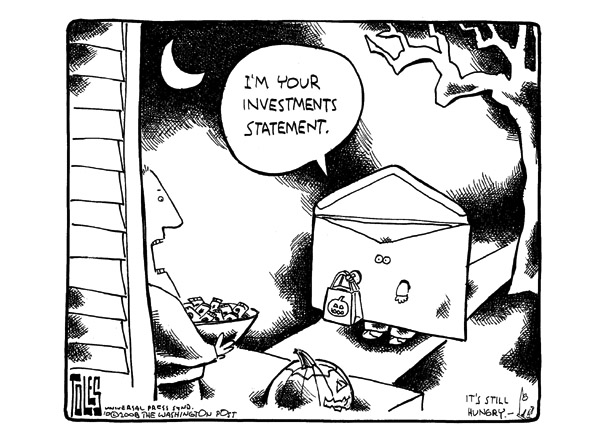
We have talked about Halloween in class and I have posted some other things about it around that time. Even though it has almost been a month since then, it delights me to revisit it. In this cartoon we have the stereotypical Halloween scenario, a creepy tree, crescent moon, jack-o-lantern, and a trick-or-treater. It is custom to dress up as something frightening for Halloween. This cartoon plays on poor economic times, which can be very serious, in a joking manner. What is more scary than opening your statement to find how much money you have, or don't have? Looking past the fact that the kid probably doesn't know what and investment statement is, and the drawing of the man's face (I'm assuming it's fear) this cartoon give me a little chuckle.

Wednesday, November 7, 2012
"Don't Trust Anyone Under 30"
Although it took most of term one, we have finally reached the conclusion of "The Dumbest Generation." Here is a look back.
The argument of Bauerlein's book goes deeper than, simply the unintelligence of the upcoming generation. I boil his argument down to two main points. Education has not progressed, even through technological advancements, and the young generation is lacking intellectual motivation. He talks extensively about what kid should be learning in the classroom, the efforts of schools to better their students, and the dwindling numbers aspiring to fill necessary careers. The investments of schools in computers, iPad, and such is not yielding positive results. Students do not retain knowledge like previous generation, but this is not completely the schools' fault. Students do not have the same desire, or need to learn. Bauerlein spend a great deal of time on teen's use of technology. They have infinite information, literally at their fingertips, through the internet, and do not wish to spend their time in study. These arguments give way to his call to action. Something must be done this generation, and they aren't headed down a path to help themselves.
I have found some places where I especially agreed with what Bauerlein said. "Young people have never been so intensely mindful of and present to one another, so enabled in adolescent contact. Teen images and songs, hot gossip and games, and youth-to-youth communications no longer limited by time or space wrap them up in a generational cocoon reaching all the way into their bedrooms." There is even a saying for this, #yolo. I very much agree that with social networking and internet devices my generation lives in the here and now. Why should study for that history test and not go out with my friends? You only live once. Another instance I found is this "Digital technology might brighten the students' outlook not only for the obvious reason that it gives them mouses and keyboards to wield, but also because it saves them the effort of acquiring knowledge and developing skills. When screens deliver words and numbers and images in fun sequence, digital fans assert, the students imbibe the embedded lessons with glee, but, in fact while the medium may raise the glee of the students, we have little evidence that the embedded lessons take hold as sustained learning in students' minds." I am a skeptic of more and more technological involvement in the classroom. My school has a plan to give iPads to students in the coming years, and for what? I do not believe that they will improve anything. I connect both of these passages to real world events and agree with the outcomes.
Perhaps it is due to the fact that they do not pertain to me, but there were segments where I disagreed with the Bauerlein. "Undergraduates in 2006, it turned out, scored 30 percent higher than students in 1982 on the narcissism scale, with two-thirds of them reaching above-average levels. The researchers traced the rise directly to self-esteem orientations in the schoolroom, and lead author Jean Twenge groused, 'We need to stop endlessly repeating, 'You're special,' and having children repeat it back. Kids are self -centered enough already.'" Sure I was praised in elementary school, and have can have a large ego regarding certain things, but in no way would I think school is producing narcissist. If anything I have been broken down by teachers. I also found this: "As long as adolescent concerns didn't take up every leisure hour of the day, as long as mentors now and then impressed the young with the importance of knowledge, as long as book reading held steady, intellectual pursuits maintained some ground in the out-of-school lives of kids. They weren't required for work or school, but they still contributed to a young person's formation. They included reading for fun, visiting museums, listening to what music educators call 'art music,' browsing in libraries and bookstores, attending theater and dance performances, joining extracurricular groups (such as French Club), and participating in politics, say by volunteering in a campaign." I was offended by this list of things that students used to do but are no longer. I am currently re-reading the Hobbit by Tolkien, playing in the pit orchestra for "The Sound of Music," have been to local, national, and international museums, and enjoy listening to some Glen Miller, music rich in American history that I would classify as "art music."
I have mixed feelings about the effectiveness of Bauerlein's argument. There were certain times when some of the things that he said made absolutely no sense, and other times when his persuasion worked. However, I find it a bit ironic, formatting the book the way he did. It is written in such a way that the generation he describes, the dumbest generation, would never read it. He cites information how teens like to skim, and get the information they need quickly. Then Bauerlein does the opposite. His 250 page book is full of facts and figures that bog the reader down. This along with his call to action show that his intended audience is older. Even though they are not the group taking the criticism, his allegations come across hard. He backs his claim up with extensive information to get his audience to believe in the problem. The sheer quantity of figures may be slightly excessive, but they provide plenty of backing to make his claim believable. My personal reaction is just "meh", I certainly wouldn't have read the whole thing on my own (which probably further proves his argument).
The argument of Bauerlein's book goes deeper than, simply the unintelligence of the upcoming generation. I boil his argument down to two main points. Education has not progressed, even through technological advancements, and the young generation is lacking intellectual motivation. He talks extensively about what kid should be learning in the classroom, the efforts of schools to better their students, and the dwindling numbers aspiring to fill necessary careers. The investments of schools in computers, iPad, and such is not yielding positive results. Students do not retain knowledge like previous generation, but this is not completely the schools' fault. Students do not have the same desire, or need to learn. Bauerlein spend a great deal of time on teen's use of technology. They have infinite information, literally at their fingertips, through the internet, and do not wish to spend their time in study. These arguments give way to his call to action. Something must be done this generation, and they aren't headed down a path to help themselves.
I have found some places where I especially agreed with what Bauerlein said. "Young people have never been so intensely mindful of and present to one another, so enabled in adolescent contact. Teen images and songs, hot gossip and games, and youth-to-youth communications no longer limited by time or space wrap them up in a generational cocoon reaching all the way into their bedrooms." There is even a saying for this, #yolo. I very much agree that with social networking and internet devices my generation lives in the here and now. Why should study for that history test and not go out with my friends? You only live once. Another instance I found is this "Digital technology might brighten the students' outlook not only for the obvious reason that it gives them mouses and keyboards to wield, but also because it saves them the effort of acquiring knowledge and developing skills. When screens deliver words and numbers and images in fun sequence, digital fans assert, the students imbibe the embedded lessons with glee, but, in fact while the medium may raise the glee of the students, we have little evidence that the embedded lessons take hold as sustained learning in students' minds." I am a skeptic of more and more technological involvement in the classroom. My school has a plan to give iPads to students in the coming years, and for what? I do not believe that they will improve anything. I connect both of these passages to real world events and agree with the outcomes.
Perhaps it is due to the fact that they do not pertain to me, but there were segments where I disagreed with the Bauerlein. "Undergraduates in 2006, it turned out, scored 30 percent higher than students in 1982 on the narcissism scale, with two-thirds of them reaching above-average levels. The researchers traced the rise directly to self-esteem orientations in the schoolroom, and lead author Jean Twenge groused, 'We need to stop endlessly repeating, 'You're special,' and having children repeat it back. Kids are self -centered enough already.'" Sure I was praised in elementary school, and have can have a large ego regarding certain things, but in no way would I think school is producing narcissist. If anything I have been broken down by teachers. I also found this: "As long as adolescent concerns didn't take up every leisure hour of the day, as long as mentors now and then impressed the young with the importance of knowledge, as long as book reading held steady, intellectual pursuits maintained some ground in the out-of-school lives of kids. They weren't required for work or school, but they still contributed to a young person's formation. They included reading for fun, visiting museums, listening to what music educators call 'art music,' browsing in libraries and bookstores, attending theater and dance performances, joining extracurricular groups (such as French Club), and participating in politics, say by volunteering in a campaign." I was offended by this list of things that students used to do but are no longer. I am currently re-reading the Hobbit by Tolkien, playing in the pit orchestra for "The Sound of Music," have been to local, national, and international museums, and enjoy listening to some Glen Miller, music rich in American history that I would classify as "art music."
I have mixed feelings about the effectiveness of Bauerlein's argument. There were certain times when some of the things that he said made absolutely no sense, and other times when his persuasion worked. However, I find it a bit ironic, formatting the book the way he did. It is written in such a way that the generation he describes, the dumbest generation, would never read it. He cites information how teens like to skim, and get the information they need quickly. Then Bauerlein does the opposite. His 250 page book is full of facts and figures that bog the reader down. This along with his call to action show that his intended audience is older. Even though they are not the group taking the criticism, his allegations come across hard. He backs his claim up with extensive information to get his audience to believe in the problem. The sheer quantity of figures may be slightly excessive, but they provide plenty of backing to make his claim believable. My personal reaction is just "meh", I certainly wouldn't have read the whole thing on my own (which probably further proves his argument).
Wednesday, October 31, 2012
Why Pumkins on Halloween?
It is common practice around Halloween to hollow out a pumpkin, carve a face on it and light the inside with a candle. But why is this related to Halloween? These creations are usually called jack-o-lanterns and there is a very extensive story behind the tradition.
The "jack" in jack-o-lantern refers to Stingy Jack. The story goes that he was a somewhat of a bum, always drunk, who liked to play trick on people. The devil heard of him and wanted to meet him, and see if he lived up to the rumors about him. One day Jack crossed paths with the devil in a bar. He trades his soul for the cost of his drinks. When the devil transformed himself into a coin to pay for the drinks, Jack put the coin in his pocket. Also in his pocket was a cross preventing the devil from transforming back into himself. Jack lets the devil out and makes another deal with him for another ten years of life. Ten years later when the devil comes back for him, Jack had another request. He asked the devil to climb a nearby tree and get him an apple. He then put crosses all around the base of the tree, and again trapped the devil. In exchange for his freedom, the devil said he would not take Jack's soul. When Jack finally died he was not allowed into heaven for all of the bad things he had done during his life. He went to the gates of Hell, but the devil honoring his agreement would not take Jack's soul. Jack asked for one final request, some light to travel back to earth with. The devil knowing he had won gave Jack an ember from the fires of Hell. Jack carried the ember in a hollowed out turnip, one of his favorite foods from when he was living. It is said that he roams the earth with his ember.
The tradition began in Ireland where they would hollow out turnips calling them "Jack of the Lantern". They started to carve faces into them and placing them near doors and windows to ward off Jack or other evil spirits. When they immigrated to the United States, the medium changed to pumpkins. Today it is common to carve out jack-o-lanterns around Halloween.
The "jack" in jack-o-lantern refers to Stingy Jack. The story goes that he was a somewhat of a bum, always drunk, who liked to play trick on people. The devil heard of him and wanted to meet him, and see if he lived up to the rumors about him. One day Jack crossed paths with the devil in a bar. He trades his soul for the cost of his drinks. When the devil transformed himself into a coin to pay for the drinks, Jack put the coin in his pocket. Also in his pocket was a cross preventing the devil from transforming back into himself. Jack lets the devil out and makes another deal with him for another ten years of life. Ten years later when the devil comes back for him, Jack had another request. He asked the devil to climb a nearby tree and get him an apple. He then put crosses all around the base of the tree, and again trapped the devil. In exchange for his freedom, the devil said he would not take Jack's soul. When Jack finally died he was not allowed into heaven for all of the bad things he had done during his life. He went to the gates of Hell, but the devil honoring his agreement would not take Jack's soul. Jack asked for one final request, some light to travel back to earth with. The devil knowing he had won gave Jack an ember from the fires of Hell. Jack carried the ember in a hollowed out turnip, one of his favorite foods from when he was living. It is said that he roams the earth with his ember.
The tradition began in Ireland where they would hollow out turnips calling them "Jack of the Lantern". They started to carve faces into them and placing them near doors and windows to ward off Jack or other evil spirits. When they immigrated to the United States, the medium changed to pumpkins. Today it is common to carve out jack-o-lanterns around Halloween.
Sunday, October 28, 2012
Trick or Treat
Trick or treat eh? A relatively uncommon phrase on 364 days of each year. However on October 31 these three word have a way of filling the stomachs of small children with sweets. People don't think twice about these words anymore or what they mean. What has changed in Halloween sinse its origin?
Trick-or-treating originally started as "souling". Poor people would go around to the rich houses and would be given soul pastries or other sweets to pray for dead relatives of the rich. Soon children started to take over this tradition, and instead of prayers they would give some kind of small performance to earn their treat. This tradition continued but has been greatly altered in common society.
In the nineteenth-century Halloween became affiliated with pranking and the phrase trick-or-treat was coined. This saying is now very one sided. If you go out on Halloween night, ring someone's doorbell you won't be denied a treat. To this extent, the phrase has lost some meaning. Children of today, who unthinkingly chime these words house after house, would be confused if they didn't receive candy. They may go complain to their parents, but I doubt that they would actually think to play a trick on someone. In a opposite sense teenagers will play "tricks" on houses for the fun of it. They know that if they want candy they can go home and eat the leftovers.
These three words are now at the center of a commercial holiday. Everyone is familiar with the phrase, but if you were to go around in June, July, or even early October and do the same thing, you would get a lot of weird looks. They are now only associated with the holiday and it is sad how a fun mischievous tradition has been changed. As Wednesday comes around I challenge you to deny candy this halloween, it might save you some money, and your house will be the scariest on the block. Maybe you will get stuck cleaning toilet paper out of your trees, but I would bet against it.
Trick-or-treating originally started as "souling". Poor people would go around to the rich houses and would be given soul pastries or other sweets to pray for dead relatives of the rich. Soon children started to take over this tradition, and instead of prayers they would give some kind of small performance to earn their treat. This tradition continued but has been greatly altered in common society.
In the nineteenth-century Halloween became affiliated with pranking and the phrase trick-or-treat was coined. This saying is now very one sided. If you go out on Halloween night, ring someone's doorbell you won't be denied a treat. To this extent, the phrase has lost some meaning. Children of today, who unthinkingly chime these words house after house, would be confused if they didn't receive candy. They may go complain to their parents, but I doubt that they would actually think to play a trick on someone. In a opposite sense teenagers will play "tricks" on houses for the fun of it. They know that if they want candy they can go home and eat the leftovers.
These three words are now at the center of a commercial holiday. Everyone is familiar with the phrase, but if you were to go around in June, July, or even early October and do the same thing, you would get a lot of weird looks. They are now only associated with the holiday and it is sad how a fun mischievous tradition has been changed. As Wednesday comes around I challenge you to deny candy this halloween, it might save you some money, and your house will be the scariest on the block. Maybe you will get stuck cleaning toilet paper out of your trees, but I would bet against it.
Sunday, October 21, 2012
Through Biased Eyes
Fans are everything in the sports world of today. After all professional athletes are in
fact only entertainers. Many
spectators live and die by the success of their team at both the collegiate and
professional levels. This is understandable,
but doesn’t excuse poor behavior at sporting events. This was brought to my attention while I was watching my
sister’s division three college soccer game. It was a reasonable physical game, which is to be expected,
but I was disappointed with the spectators on both sides. They were very vocal with their complaints
on both called and uncalled fouls. Specific individuals on both sides repeatedly voiced their
dissatisfaction with the referee quite loudly. During this I laughed to myself at their opinionated views,
which usually had to do with calls involving their children, as most fans were
parents. Not many outsiders come to watch division three soccer. The center ref was doing a fine job calling fairly both
ways. However, many fans were unable
to see this, their eyes clouded by the bias for their team.
I have experience with officiating and know firsthand how
annoying and obnoxious parents an fans can be. A close call that goes their way is a “good call” but that
same call that goes against them is cause for complaint. Baseball is much worse than soccer in
this sense. Balls and strikes are
an umpire’s judgment, and they are much more reliable standing directly behind the plate than the fan sitting at an angle fifty rows back. To make it worse, both baseball and
football broadcasters have the ability to digitally chart balls and strikes and
view plays in slow motion, and asses the accuracy of calls. Television viewer see these potential
missed calls and then come to not trust the officials. This leads to accusations against the
refs and the officials are put at fault.
No bad call is so significant that it can be given fault of
a loss. No team in any sport plays
so perfectly that they can say they would have won had it not been for this or
that call. Spectators need to
realize this and also recognize their biases. So sit down, shut up, and watch the game. If you feel that your team should have
won, well, too bad they should have played better, yelling at the official
isn’t going to help.
Sunday, October 14, 2012
Humor Analysis
I find Jim Gaffigan to be quite funny, and by looking at his techniques we can discover why he is funny.
Gaffigan takes real world issues and applies them to whales as a base for his humor. He begins by criticizing them for being fat. This is the base for the rest of his jokes. His depressed whale noise leads him to debate why whales might be sad. He lists very shallow reasons for their sadness like being bad at hide and seek. This springboards into his bit about whales' body image. Like humans on diets the whale claims that he only eats plankton but the little fish interject otherwise. Many people can relate to the diet analogy. They have felt of seen the difficulties of trying to stick with a diet. Whether the audience realizes it or not, Gaffigan is taking a real issue and applying it in a satiric way.
"Don't bring up whales around my dad" He compares whales to controversial issues. It might not be wise to bring up the economy or Iran around "my dad" but whales, probably okay. We all know people like this, that will go off at any mention of a certain issue. In a way Gaffigan is getting us to laugh at ourselves or our family.
Finally he parallels the anatomy of whales and humans. No matter the context people will always find poop jokes funny. A serious health problem that grows with age is made hysterical by a reference to a whale who recently visited the Indian Ocean
In a different contexts Gaffigan gets us to laugh at ourselves and the world around us. We know that body image isn't a funny topic, but can't stop laughing at a fat whale in denial portrayed with a funny voice.
Sunday, October 7, 2012
People Watching at the Mall
Here are my accounts from Ridgedale Mall, quietly observing and inferring about people and events that happened around me.
An Indian man is at the Crocs stand buying shoes for his middle school son, who has desires to be elsewhere. He asks his son questions about the preferences on the shoes, and gets annoyed by the one word responses. The man talks with the saleswoman about the shoes while the son plays with his. Kendama. He is balding, early fifties, first generation American, with a good enough career to support a family, but is tired from work. He wants his son to succeed and will soon be a helicopter parent pushing his child to academic excellence. They finally settle on a pair and the saleswoman checks them out. The man starts to leave, the son waits for a moment, distracted, then follows ten paces behind, not wanting to associate with his father.
The mall security guard paces the center rotunda of the mall. Only a few shoppers ask him questions. He answers them easily with a small gesture in the direction of what they are looking for. The job is monotonous, and tonight is a quiet week night, the same as any other. He stops to watch the football game playing on one of the televisions at an electronics kiosk. There is little interest in either team playing, but it helps pass the time until he gets off work. He isn't overly excited about his job, but without a college degree he doesn't know where else he could work. He is neither married, nor has any children. The representative at the kiosk comes over and talks to him. They know each other, but are not friends. After making small talk about the game for a minute the sales rep is pulled back to work by a customer. The security guard realizes he should make another round as well. Suddenly cold, he zips up his jacket with SECURITY printed in large white letters on the back and walks off.
A family of five walks by me into Macy's. They are going to their Lexus crossover parked outside in the Macy's lot. The mother and three daughters, all under 10, are dressed nicely. The mother talks with her oldest about which of her jackets would go best with her beret. She is a housewife in her mid-thirties who has never worked a day in her life. Her parents were well off and paid her way through college. However, she got married right after graduating and never got a job. She dresses nicely because of the attention it gets her and because she can. The husband is the opposite. He works hard, and easily makes enough to support the high standard of living for his family. He travels a lot and doesn't get to see his girls as much as he would like. When he is home he would rather be comfortable than look good. His t-shirt and sweatpants contrast the suit he wears to work every day. They head home all having enjoyed the night out.
The events told are all true, I have filled in the surrounding details because it's interesting and fun! Go out and people watch, make up stories about the people you see.
The events told are all true, I have filled in the surrounding details because it's interesting and fun! Go out and people watch, make up stories about the people you see.
Sunday, September 30, 2012
Moon Landing, the Success of the 60s?
Did we indeed land men on the moon? If you were to take a poll the general consensus would be that we were successful. Yet, there are many conspiracy theorist who would say otherwise. Here is my take on why we didn't actually make it.
If we did land on the Moon why are we lacking physical evidence. Some people say seeing is believing, but I am less than convinced by the video footage. Do we have a way of knowing that it wasn't filmed in a secret warehouse some place in a restricted area of Arizona? There is also no conclusive data that can be used to prove much of anything about the moon. As for the moon rocks, with some doctoring I could make one from a rock I dug up in my backyard.
The United States had everything to gain or lose from the endeavors of the space race. During the height of the Cold War, victory in the race to the moon proved a strong propaganda piece and cause for national unity. The Soviet Union was the first to put both a satellite and man into space, but we somehow beat them to the moon.
Finally, if we did land on the moon why haven't we gone back. After the Apollo missions the only space expeditions have been to the International Space Station and Mars. Why would we have not landed on the non-Earth side of the moon by now.
It is common belief that we have put men on the moon in multiple trips, but there are many questions that surround not only the moon landings but space exploration as well.
If we did land on the Moon why are we lacking physical evidence. Some people say seeing is believing, but I am less than convinced by the video footage. Do we have a way of knowing that it wasn't filmed in a secret warehouse some place in a restricted area of Arizona? There is also no conclusive data that can be used to prove much of anything about the moon. As for the moon rocks, with some doctoring I could make one from a rock I dug up in my backyard.
The United States had everything to gain or lose from the endeavors of the space race. During the height of the Cold War, victory in the race to the moon proved a strong propaganda piece and cause for national unity. The Soviet Union was the first to put both a satellite and man into space, but we somehow beat them to the moon.
Finally, if we did land on the moon why haven't we gone back. After the Apollo missions the only space expeditions have been to the International Space Station and Mars. Why would we have not landed on the non-Earth side of the moon by now.
It is common belief that we have put men on the moon in multiple trips, but there are many questions that surround not only the moon landings but space exploration as well.
Singer : Hearne The Animal Equation
Here are systems of equations for the view of Vicki Hearne and Peter Singer
Singer: Animal Rights = Animal Suffering
Animal Suffering :is not less than: Human Suffering
Hearne: Animal Rights = Animal Happiness
Animal Happiness :is not equal to: -(Animal Suffering)
The only intersection of these equations on a coordinate grid is at animals should not suffer.
Sunday, September 23, 2012
Emotional and Logical Reasoning: The Power of Imagery
In response to the npr clip on how the human brain goes about making decisions all I can say is, wow that's really neat. Not many people think about how they think. Just the concept of it seems confusing, but the studies that they explained on npr were clear. The brain is utilitarian and logical in decision making unless there is vivid imagery. The imagery sends the brain on a separate track of emotional decision making. Instead of thinking logically about a situation your emotions decide for you. In the examples that they explained I realized what they were saying was true for myself as well.
This gives scientific proof to the effectiveness of imagery. Why let your audience think when you could essentially, make decisions for them with imagery? It's barely short of mind control if you can use it affectively. As I think about it, it makes more sense to me. Human beings cannot be rational all the time. Whether you try to block them out or not, emotions will always affect your though process. If we were solely logical we would be without the iconic Darth Vader. Anakin Skywalker wouldn't have let the anger and fear he experienced from his nightmares affect him.
As much as we might like to think we are in control of our though process, there is still much that changes in our minds subconsciously. Before I go I'll leave you with an example, a test, some food for thought. What is worse, forcing one in five to jump out of a hot air balloon that is too heavy and about to crash into a bluff, or shooting someone in the back who has four hostages at gunpoint?
This gives scientific proof to the effectiveness of imagery. Why let your audience think when you could essentially, make decisions for them with imagery? It's barely short of mind control if you can use it affectively. As I think about it, it makes more sense to me. Human beings cannot be rational all the time. Whether you try to block them out or not, emotions will always affect your though process. If we were solely logical we would be without the iconic Darth Vader. Anakin Skywalker wouldn't have let the anger and fear he experienced from his nightmares affect him.
As much as we might like to think we are in control of our though process, there is still much that changes in our minds subconsciously. Before I go I'll leave you with an example, a test, some food for thought. What is worse, forcing one in five to jump out of a hot air balloon that is too heavy and about to crash into a bluff, or shooting someone in the back who has four hostages at gunpoint?
Sunday, September 16, 2012
The Writing Process
Writing is a difficult thing. Writing about writing is even more difficult. Either way, I'll take a crack at it and see what I come up with.
As I sit here and stare at my computer screen, I am faced with what I believe to be the hardest part of writing, simply starting. Often when I write I know what topic I am supposed to or want to write on. The difficulty comes in narrowing that general topic down into specific enough terms to write. Take this example: I want to write about dogs. There is my topic, but I cannot physically write all there is to know about dogs. Maybe I want to focus on a certain breed of dog, my personal preferences in dogs, or a past experience that I associate with dogs or that directly involved one. What works for me is to simply dumping all possible writing subjects onto the paper. Usually by doing this, something in my mind will click, and I will get an idea to write on. If after all that you are still drawing a blank, well, that sucks, I don't have anything else that could help you.
At this point you have probably still not started writing the actual piece. And even though you have narrowed down your topic it is still hard to put the first words on the page. I have no advice for this but to force yourself to write something. As long as it is related to your topic it's good. Once you have a few sentences, or maybe even a few words, more will to come to you. The foreboding of the blank page will leave you and the rest is just putting your ideas down.
The rest is fairly simple, or it sounds very simple. The rest is revision. Writing in any stage can be revised more, added to, subtracted from, or condensed. Give your writing to others, have them read it, comment on it and give you suggestions. This step can go on for however long or short a time that you want. With some finishing touches you can call it complete, even though writing is never truly complete, you can say that you're done.
I am lacking in a witty way to end this post so, have fun writing!
As I sit here and stare at my computer screen, I am faced with what I believe to be the hardest part of writing, simply starting. Often when I write I know what topic I am supposed to or want to write on. The difficulty comes in narrowing that general topic down into specific enough terms to write. Take this example: I want to write about dogs. There is my topic, but I cannot physically write all there is to know about dogs. Maybe I want to focus on a certain breed of dog, my personal preferences in dogs, or a past experience that I associate with dogs or that directly involved one. What works for me is to simply dumping all possible writing subjects onto the paper. Usually by doing this, something in my mind will click, and I will get an idea to write on. If after all that you are still drawing a blank, well, that sucks, I don't have anything else that could help you.
At this point you have probably still not started writing the actual piece. And even though you have narrowed down your topic it is still hard to put the first words on the page. I have no advice for this but to force yourself to write something. As long as it is related to your topic it's good. Once you have a few sentences, or maybe even a few words, more will to come to you. The foreboding of the blank page will leave you and the rest is just putting your ideas down.
The rest is fairly simple, or it sounds very simple. The rest is revision. Writing in any stage can be revised more, added to, subtracted from, or condensed. Give your writing to others, have them read it, comment on it and give you suggestions. This step can go on for however long or short a time that you want. With some finishing touches you can call it complete, even though writing is never truly complete, you can say that you're done.
I am lacking in a witty way to end this post so, have fun writing!
MJ
Wednesday, September 5, 2012
Subscribe to:
Posts (Atom)